



AIKON Article Details | AIKON
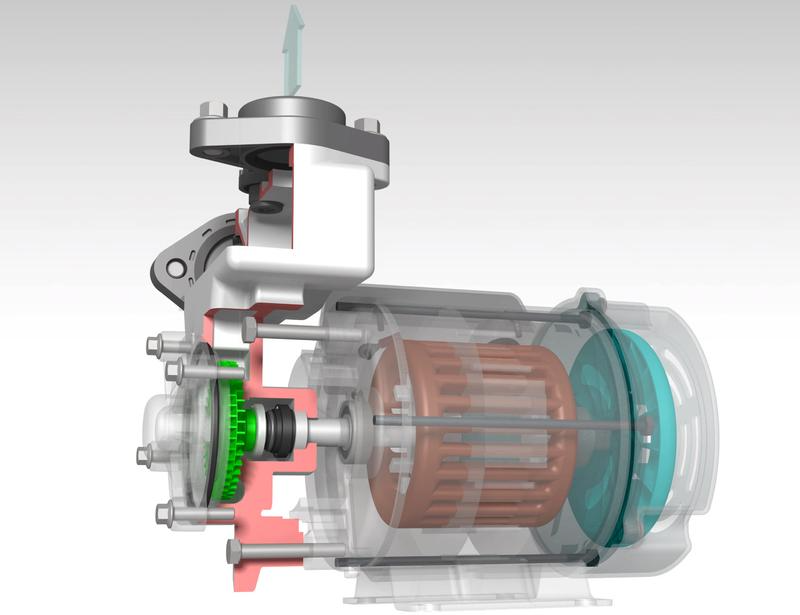
The working principle of a centrifugal pump
2025-02-14 16:00:43
The Rotation of the Impeller and Liquid Intake
When the centrifugal pump starts up, the motor or other power source drives the pump shaft to rotate, which in turn drives the impeller to rotate at high speed. During the rotation of the impeller, its blades powerfully propel the surrounding liquid to rotate with it. Since the liquid in the center area of the impeller experiences relatively small centrifugal force, while the liquid at the edge of the impeller experiences larger centrifugal force, a relatively low - pressure area is formed at the center of the impeller. Under the action of atmospheric pressure, external liquid is continuously drawn in from the pump inlet to the center of the impeller to fill this low - pressure area, realizing the continuous intake of liquid.
Liquid Acceleration and Pressure Increase
As the impeller continues to rotate, the drawn - in liquid, driven by the blades, flows continuously towards the outer edge of the impeller along the blade passages of the impeller. In this process, the speed of the liquid increases significantly, gaining a large amount of kinetic energy. When the liquid reaches the outer edge of the impeller, its speed can reach tens of meters per second. At this time, part of the kinetic energy of the liquid is converted into pressure energy, and the pressure of the liquid also increases. The blade design of the impeller causes the flow direction of the liquid to change, further optimizing the flow state of the liquid and improving the energy conversion efficiency.
The Function of the Pump Casing and Liquid Discharge
The high - speed liquid flowing out of the impeller enters the pump casing. The spiral structure of the pump casing gradually increases the flow cross - sectional area of the liquid, gradually reduces the flow speed, and further converts the kinetic energy of the liquid into pressure energy. In this process, the pressure of the liquid continues to increase and finally reaches a relatively high pressure level. The high - pressure liquid is discharged through the outlet pipe of the pump casing, completing the liquid transportation task. The pump casing also serves to collect the liquid flowing out of the impeller and guide it to the outlet, ensuring the smooth and stable flow of the liquid.
Energy Conversion Process The working process of the centrifugal pump is essentially an energy conversion process. The mechanical energy provided by the motor and other power sources is transmitted to the impeller through the pump shaft, and the impeller converts the mechanical energy into the kinetic energy of the liquid, enabling the liquid to obtain high - speed motion. Subsequently, under the action of the pump casing, the kinetic energy of the liquid is further converted into pressure energy, the pressure of the liquid increases, thus realizing the transportation of the liquid. This energy conversion process follows the law of energy conservation. Through the carefully designed structure of the impeller and pump casing, the energy conversion efficiency is maximized, ensuring the stable and efficient operation of the centrifugal pump under various working conditions.
In short, the centrifugal pump, with its ingenious structural design and unique working principle, plays an indispensable role in many fields. A deep understanding of its working principle is of great significance for the selection, use, maintenance and optimization of the centrifugal pump. It helps to improve production efficiency, reduce energy consumption, extend the service life of equipment, and provide strong support for the development of modern industry and life.