



AIKON Article Details | AIKON
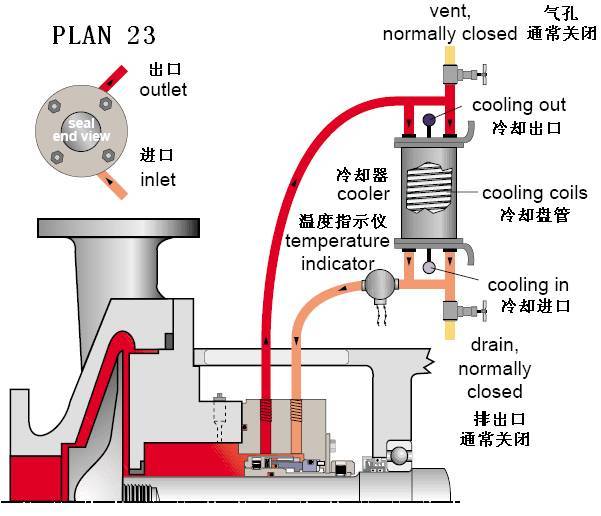
Introduction to the 23rd Washing Plan
2025-03-28 17:19:45
Summary:
Plan 23 is an API (American Petroleum Institute)-defined external flushing solution for mechanical seals. Its core function is to cool the seal chamber and flush the sealing surfaces using a continuous flow of clean external fluid. It is ideal for applications involving high-temperature media, vaporization-prone fluids, or those requiring stable seal chamber pressure control.
I. What is Plan 23?
Plan 23 is an external flushing scheme outlined in API standards for mechanical seals. Its primary features include:
• Purpose: Cools the seal chamber and flushes the sealing faces via an external circulation system.
• Key Applications:
• High-temperature media (e.g., hot water pumps, thermal oil pumps).
• Media prone to vaporization or scaling (e.g., salt solutions, high-viscosity liquids).
• Environments needing stable seal chamber pressure regulation.
II. How Does Plan 23 Work?
The operational principle revolves around "external cooling + continuous flushing", following this process:
1. Flush Fluid Source: A portion of liquid is diverted from the pump discharge.
2. Cooling Phase: The fluid passes through a heat exchanger (or cooler) to reduce temperature.
3. Seal Flushing: The cooled fluid injects into the seal chamber to dissipate frictional heat and prevent crystallization or particle buildup on sealing surfaces.
4. Recirculation: The mixture of flush fluid and minimal leakage returns to the pump inlet or an external recovery system.
III. Core Components of Plan 23
• Heat Exchanger: Reduces flush fluid temperature (commonly shell-and-tube or plate-type).
• Piping & Instrumentation: Pressure gauges and temperature sensors monitor system performance.
IV. Four Major Advantages of Plan 23
1. Significantly Reduced Temperatures: External cooling lowers seal chamber temperatures by 20–50°C, preventing thermal distortion of sealing rings.
2. Extended Seal Life: Continuous flushing minimizes fouling and wear on sealing surfaces.
3. Adaptability to Harsh Conditions: Reliable operation under high-temperature, vaporization-prone, or scaling media.
4. Ease of Maintenance: Independent of internal pump media; no need to drain the pump during maintenance.
V. Typical Application Scenarios
• High-Temperature Hot Water Pumps: Boiler feed pumps in power plants.
• Chemical Process Pumps: Transporting crystallizing media like molten salt or polymers.
• Refinery Thermal Oil Pumps: Media temperatures exceeding 150°C.
• Vaporizable Media Pumps: Liquefied petroleum gas (LPG), liquid ammonia.
VI. Key Considerations
• Flush Fluid Compatibility: Ensure chemical compatibility with the pumped medium (e.g., water for water-based fluids, light lubricants for oils).
• Flow Rate Control: Insufficient flow risks inadequate cooling; excessive flow may cause pressure fluctuations in the seal chamber.
• Heat Exchanger Maintenance: Regular descaling/cleaning to maintain heat transfer efficiency.
• Seal Directionality: Plan 23 is designed for single-face seals; dual-face seals require supplementary solutions like Plan 53.
By combining external cooling and proactive flushing, Plan 23 provides robust protection for mechanical seals in demanding environments. Its core benefits—extended service life, reduced downtime, and adaptability—make it invaluable for industries such as power generation, petrochemicals, and refining. Proper fluid selection and routine maintenance are critical to maximizing its performance.