



AIKON Article Details | AIKON
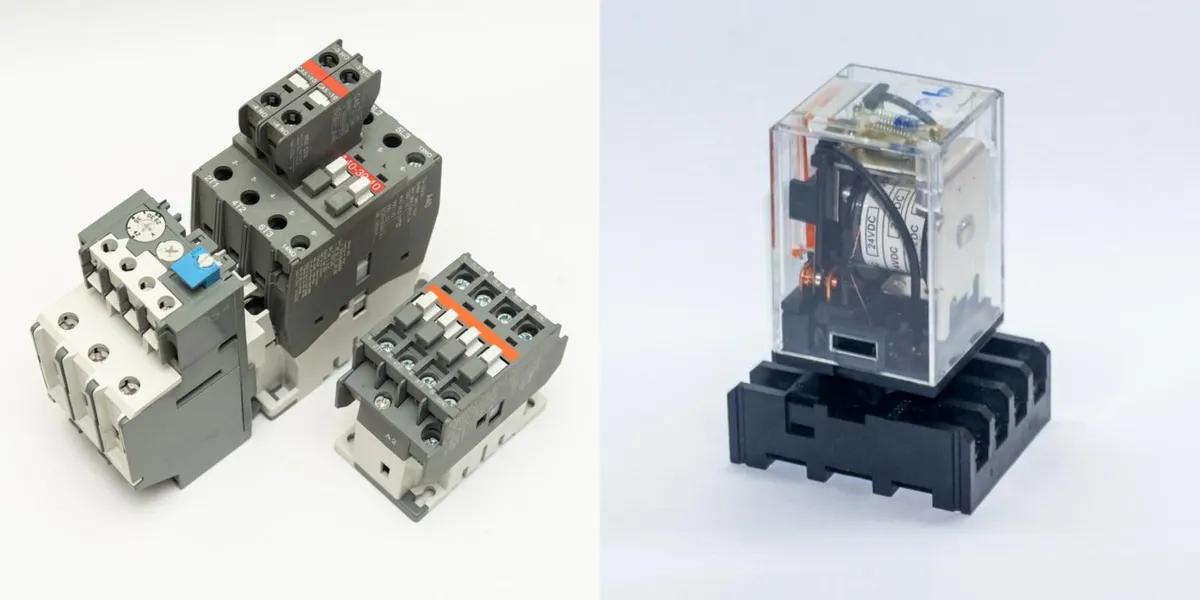
The difference between relays and contactors
2025-03-28 17:23:01
In industrial automation, power systems, and household appliances, both relays and contactors play vital roles. While their fundamental function is to control electrical current flow, there are significant technical and application differences between them. To understand these differences, it is essential to first grasp their definitions and basic structures.
A relay is an automatic switching device that controls a larger current using a smaller one. It typically consists of a coil, contacts, a spring, and a casing. When the coil is energized, it generates a magnetic field that causes the contacts to move, thus switching the circuit on or off. The primary characteristics of relays include signal amplification, remote control, automatic regulation, and electrical isolation, making them widely used in low-power control circuits. For instance, in PLC control systems, relays are often employed to switch small-current signals, enabling logical control and signal conversion. Moreover, relays are highly flexible and can be used in various electronic and electrical devices such as alarm systems, automation control equipment, and communication devices.
In contrast, a contactor is specifically designed to control high-current, high-power loads. Its structure is similar to that of a relay, also consisting of a coil and contacts, but with larger contact surfaces, usually featuring three-phase normally open contacts to handle higher loads. The working principle of a contactor involves the coil generating a magnetic field when energized, pulling the movable contacts to connect with the stationary contacts, thereby completing the circuit between the power supply and the load. When the coil is de-energized, the magnetic field disappears, and the contacts separate, cutting off the power to the load. Since contactors are built to withstand large currents, they are extensively used in industrial control systems, such as motor start-stop control, large-scale lighting equipment, frequency converters, and heating devices.
The difference in current and voltage handling capabilities between relays and contactors is also significant. Relays are generally used in low-current, low-power circuits, with rated currents ranging from a few milliamperes to several tens of amperes. Contactors, on the other hand, are designed for high-power equipment, with rated currents reaching several hundred amperes or more. Therefore, when selecting between the two, the load size must be considered. For example, if controlling the start and stop of a motor, using a relay alone may not withstand the inrush current during motor startup, whereas a contactor can reliably handle such a load.
Another key difference lies in their operational lifespan. Relays tend to have a longer mechanical lifespan, but due to their smaller contact surfaces, they are more susceptible to damage from electrical arcing in high-load environments. Contactors, on the other hand, have larger contacts and are often equipped with arc suppression devices, allowing them to operate more stably in high-power environments. However, because contactors handle larger working currents, their mechanical wear is more significant than that of relays, meaning their lifespan may be relatively shorter in high-frequency switching operations.
In industrial control systems, relays and contactors are often used together. For instance, in complex automation control setups, a PLC can use relays to control the coil of a contactor, allowing a low-current signal to reliably control the operation of high-power equipment. This combination enhances system safety and provides greater flexibility in control.
While relays and contactors share a similar fundamental function, they differ significantly in terms of application scope, working current, electrical characteristics, and lifespan. Relays are mainly used for low-power signal control, such as in logic circuits and signal transmission, while contactors are more suitable for high-power load control, such as motors, heaters, and lighting systems. In practical applications, selecting the appropriate device based on specific control requirements is essential to ensure the safety, stability, and reliability of the electrical system.